Your website is generating buying signals right now. The problem is that most of them disappear the moment a visitor picks up the phone.
B2B companies in distribution, manufacturing, and complex industrial markets face a version of this every quarter. Traffic goes up. Engagement looks decent. Someone exports a report from Google Analytics, presents it in a meeting, and then the room goes quiet. Because the only question anyone actually cares about (what did all that traffic produce in revenue?) has no answer that anyone can defend.
This is not a marketing problem. It is a structural one. And it is fixable.
Why B2B Website Attribution Breaks Down
The buying journey in complex B2B environments does not end at a checkout page. A prospect finds you through a paid search ad or an organic result, spends time on your product pages, and then does what B2B buyers have always done. They call. They send an email. They ask their rep at a trade show. The deal closes weeks or months later, and finance generates an invoice from a system your website has never touched.
By the time that revenue lands, the connection back to the original visit is gone. Your web analytics platform stopped tracking the moment the buyer left the page. Your CRM knows the deal exists but has no idea which campaign started it. Your ERP or finance system knows the invoice was paid but has no record of the marketing that earned it.
Every piece of the journey is real. It just lives in a different system, and no one can put it back together.
Why can’t CRM just capture where the lead came from?
CRM captures what a rep enters, which is often incomplete, inconsistent, or entered after the fact. Even when a rep does log a source, it reflects what the buyer said, not what actually drove the visit. A buyer who found you through a retargeting ad will often say “I just Googled you.” Without cross-system connection from the visit itself through to the deal, that first-touch data is lost before anyone has a chance to record it accurately.
The Three Breaks in the Journey
When companies try to trace website traffic to revenue, they typically run into the same three failure points.
The first is identity. Most website traffic is anonymous. A visitor from a named account in your target market looks identical to a random visitor until they fill out a form, and most B2B buyers never do. Without identity resolution, you are working with aggregate traffic numbers that tell you volume but nothing about who.
The second is continuity. Even when a buyer does identify themselves through a form or a call, the handoff from marketing to sales often breaks the chain. The CRM deal gets created, but the campaign that generated the call does not travel with it. The phone call that converted is logged as an activity, not as a revenue event tied to a source.
The third is reconciliation. Finance closes the loop on revenue, but finance operates in the ERP, not in the CRM and certainly not in web analytics. Closed-won deals that were never invoiced, payments that were never matched to a deal, revenue that landed but was never attributed to any campaign: these are not edge cases. They are patterns that show up in almost every company that has not connected its systems at the revenue level.
What does “revenue leakage” actually mean in this context?
Revenue leakage refers to closed-won deals that were never converted to invoices, or invoices that were never matched to payments. In complex B2B environments with long sales cycles, multiple reps, and high deal volume, deals can close in the CRM and then stall before finance processes them. The revenue exists on paper but never arrives. Identifying and recovering those deals is often the fastest path to measurable financial impact, and it has nothing to do with generating new traffic.
What Connecting the Journey Actually Requires
Closing the gap between a website visit and a revenue event requires three things working in sequence, not three separate tools bolted together.
Visitor intelligence that names accounts, not just sessions. A meaningful portion of anonymous web traffic can be resolved to a company with the right identity layer in place. That turns “someone from an unknown source visited your heavy equipment product page four times this week” into actionable account intelligence your sales team can act on before the buyer ever calls.
Cross-source attribution that follows the deal, not just the click. When a visitor becomes a call, and that call becomes a CRM opportunity, and that opportunity becomes a closed-won deal, and that deal becomes an invoice, the attribution needs to travel with it. That means connecting your paid channels, your call-tracking system, your CRM, and your ERP into one continuous journey record, without rebuilding any of them.
Plain-English answers that do not require a data analyst. If the only way to ask “which campaigns produced revenue last quarter, including phone leads” is to file a ticket and wait four days, no one will ask it often enough to make decisions with it. The connection has to be queryable by a CMO, a CFO, or a CRO in the moment they need the answer.
How is this different from just building better reports?
Better reports still require someone to define the question, build the query, and interpret the output. What changes with connected attribution is that the underlying data model actually links the visit to the deal to the invoice, so the answer to “what did marketing produce?” is not a matter of interpretation. It is a matter of looking at a connected record. The question becomes answerable by anyone, not just the person who built the report.
What Changes When the Journey Is Connected
The most immediate change is that the quarterly attribution argument stops. Marketing and finance stop reporting different revenue figures for the same period, because they are finally looking at the same connected record instead of two fragments of the same journey.
In practice, that shift creates three downstream effects.
Marketing can defend its budget with revenue, not clicks. Which campaigns produced closed-won deals? Which channels drove the phone calls that converted? Which accounts are warming up on the website right now, before a rep has reached out? These questions become answerable in seconds, not days.
Finance can reconcile spend to revenue and catch what was missed. Deals that closed in the CRM but were never invoiced. Payments that arrived but were never matched. Revenue that exists in the ERP but has no marketing origin on record. Recovering that leakage is often the single fastest path to measurable financial impact for companies that have not connected their systems.
Sales can see account intent before the call comes in. When a named account that has not ordered in eighteen months starts visiting product pages and pricing sections, that is a signal worth acting on. Connected visitor intelligence surfaces that signal in time for a rep to reach out proactively, not reactively.
Does this only work if we have a large marketing budget?
No. The value of connected attribution scales with the complexity of your sales cycle, not the size of your media spend. Companies with long sales cycles, multiple buyer touchpoints, and offline conversion paths benefit the most, because those are the environments where attribution breaks down most severely. A company with a modest marketing budget but a high-value, rep-driven sales process has more to gain from attribution than a company with a large digital ad spend that closes in a cart. The complexity of the sales cycle matters more than the size of the media budget.
How FocusPoint Nexus Closes the Loop
FocusPoint Nexus is a business strategy and attribution platform built specifically for companies in distribution, manufacturing, and complex B2B environments. It is not a reporting tool. It is the connective layer that follows a buying journey from an anonymous website visit through every system the deal touches, all the way to a paid invoice.
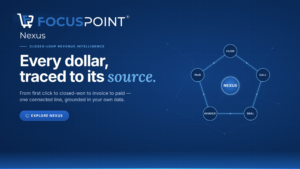
Nexus reads visitor intelligence from your website, connects it to call-tracking data, follows it into your CRM, reconciles it against closed-won deals, and matches it to invoices and payments in your ERP. The full journey (click to call to deal to invoice to paid) becomes a single connected record that any executive can query in plain English.
A CMO can ask “which campaigns produced revenue last quarter, including phone leads” and get an answer with a confidence signal attached, not a ticket number. A CFO can surface closed-won deals that never reached finance. A CRO can see which accounts are showing buying intent on the website before a rep has touched them.
Nexus modules are structured around the C-suite roles that need this intelligence most. Marketing Nexus connects campaign investment to closed-won revenue. Finance Nexus surfaces revenue leakage and closed-loop revenue intelligence. Sales Nexus monitors pipeline velocity and flags stuck deals. Each module starts at approximately $30K per year, with a three-module package starting around $75K and Full Nexus starting around $120K annually. For select strategic accounts, an outcome-aligned option ties a portion of pricing to revenue leakage recovered in year one, which means the platform can pay for itself before the annual invoice is due.
Deployment happens in weeks, not months. No middleware. No ripping out existing systems. Nexus works on the stack you already run.
The buying signal your website is generating every day is recoverable. It scatters the moment a buyer moves from your site to your sales process, but the data still exists across your systems. A connected attribution layer can follow it from visit to paid invoice.
If you want to see what your website has actually been producing in revenue, book a discovery call. We will map the journey against your specific systems and show you where the signal is going cold.