Your sales team closes a deal. The order enters SAP Business One. Someone on the inside manually reviews it, routes an approval, checks the customer’s pricing tier, confirms stock allocation, and eventually releases it to fulfillment. That sequence happens dozens of times a day. Multiply it across a year, and you’re looking at an enormous block of operational capacity consumed by work that should not require a human at all.
Operational leverage through ecommerce automation is not a technology story. It’s a growth story. The distributors and manufacturers gaining the most ground right now are the ones who’ve stopped treating ecommerce as a digital catalog and started treating it as an intelligent revenue engine that runs complex B2B workflows without constant intervention.
What Operational Leverage Actually Means in B2B Ecommerce
Operational leverage, in the context of B2B ecommerce, means your revenue-generating capacity grows faster than your operational headcount. You process more orders, serve more customers, and handle more complexity without adding proportional cost.
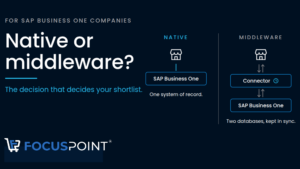
For SAP Business One customers in distribution and manufacturing, this is where ecommerce automation delivers its most measurable return. When the ecommerce layer is built natively on SAP, every order, every customer-specific price, every approval rule, and every workflow condition is already known to the system. There’s nothing to reconcile, no middleware translating between platforms, no manual re-entry. The engine handles it.
That’s the difference between ecommerce as a channel and ecommerce as a growth infrastructure.
Where Manual Processes Are Quietly Costing You
Before addressing what automation enables, it helps to be specific about where the friction lives.
Order Entry and Approval Routing
In complex B2B environments, orders often require validation: credit checks, custom pricing confirmation, multi-location stock allocation, or manager approval for orders above a threshold. When these steps are manual, each one is a potential delay and a potential error. When they’re automated through the ecommerce platform, they execute in the background, consistently, without someone managing the queue.
Customer-Specific Catalog and Pricing Management
An industrial distributor with hundreds of accounts, each carrying its own pricing agreement and product visibility rules, faces a maintenance burden that scales poorly. Updating pricing manually across accounts is time-consuming and error-prone. An ecommerce engine built on SAP Business One surfaces the right catalog and the right price to each customer automatically, because that data already lives in SAP.
Reorder and Predictive Ordering Workflows
Customers who buy the same products on a predictable cycle are a significant revenue opportunity that most distributors under-serve. A well-configured ecommerce platform can surface predictive reorder prompts based on purchase history, automate standing order schedules, and reduce the friction of routine replenishment to nearly zero. The customer self-serves. The order flows. No rep required.
The Self-Service Layer Is a Revenue Layer
Self-service is often framed as a cost-reduction play. It is that. But for B2B companies with established customer relationships, self-service ecommerce is also a revenue expansion mechanism.
When customers can access their account history, track shipments, reorder from past purchases, manage their own contacts and addresses, and get answers without calling your team, two things happen. First, your inside sales and customer service staff redirect their time toward higher-value conversations. Second, customers order more often because the friction of placing an order is gone.
A distributor managing a field service customer base is a clear example. Technicians in the field need parts quickly. If they can pull up a mobile ecommerce portal, find the exact part by equipment type or serial number, confirm it against their customer-specific catalog, and place the order without calling anyone, the distributor captures that order. Without that capability, the technician calls a competitor who makes it easier.
Self-service is where operational leverage and customer experience intersect. It reduces cost and grows revenue at the same time.
Advanced Workflows Without Custom Development
One of the persistent challenges for SAP Business One customers evaluating ecommerce platforms is complexity. B2B transactions are not simple. They involve multi-level approvals, contract pricing, account hierarchies, EDI requirements, punchout catalog integrations, and sometimes a mix of direct and channel sales.
Generic ecommerce platforms struggle here. They’re built for simpler environments and require significant custom development to handle B2B complexity. That development is expensive, fragile, and slow to adapt.
FocusPoint Ecommerce is built for this environment specifically. The platform’s plugin architecture absorbs CRM, call-tracking, EDI, punchout, and channel variability without disturbing the SAP core. Advanced workflow and approval logic is configurable, not coded. When a business rule changes, the adjustment happens in the platform, not in a development sprint.
In practice, this means a manufacturer can implement tiered approval routing for large orders, customer-specific payment terms, and multi-location fulfillment logic without a custom build. The business runs its rules. The platform executes them.
What Ecommerce Automation Looks Like Across the Operation
It helps to see this concretely across a few different operational contexts.
For an electronics or electrical wholesaler, automation might mean that high-volume repeat customers place orders through a self-service portal that applies their contract pricing, routes to the correct warehouse automatically, and generates the invoice in SAP without a single manual step. The team that used to process those orders is now focused on new account development.
For a heavy equipment dealer, automation might mean that parts orders placed through the ecommerce platform trigger parts availability checks, service scheduling prompts, and warranty validation simultaneously, all before a human reviews the order. What used to take hours of coordination resolves in minutes.
For an industrial distributor with a mixed B2B and B2C customer base, automation means the platform presents the right experience to each customer type, applies the right pricing and catalog rules, and handles the operational differences between a commercial account and a direct consumer without requiring two separate systems.
The Connection Between Ecommerce Automation and Executive Visibility
Operational leverage through ecommerce automation creates a secondary benefit that’s often overlooked: it produces cleaner, more complete operational data.
When orders flow through a structured ecommerce engine connected natively to SAP, every transaction is recorded consistently. Order origin, customer behavior, fulfillment path, and revenue attribution are all captured. That data becomes the foundation for the kind of executive intelligence that tells leadership not just what happened, but why, and what to do next.
FocusPoint Nexus connects to that ecommerce data stream, along with CRM, call-tracking, paid channels, and finance, to give the COO visibility into operational throughput and the CFO a closed-loop view of revenue from digital channels. Ecommerce automation doesn’t just reduce friction. It builds the intelligence layer that makes better decisions possible.
Deploying Without Disruption
A common concern among SAP Business One customers evaluating ecommerce automation is deployment complexity. The assumption is that a platform capable of handling B2B complexity will take a long time to stand up and will require significant IT involvement.
FocusPoint Ecommerce deploys in weeks, not months. There’s no implementation fee and no transaction fees. The subscription is based on the modules you use. Because the platform is built natively on SAP Business One, there’s no middleware layer to configure and no data synchronization architecture to maintain. A single source of support covers the ecommerce platform and the SAP environment together.
That’s a meaningful difference from evaluating a generic ecommerce platform and then separately engaging an SAP consultant to manage the integration.
The Compounding Return
The operational leverage argument for ecommerce automation is strongest when you think about it over time. In the first months, the return comes from removing manual steps and reducing error rates. Within a year, the return compounds as customer self-service adoption grows, predictive ordering captures revenue that would have been lost, and the operational team’s capacity shifts toward higher-value work.
The distributors and manufacturers who are hardest to compete with are not the ones with the largest teams. They’re the ones whose ecommerce infrastructure runs their complexity efficiently enough that they can grow without adding proportional cost. That’s what operational leverage through ecommerce automation actually delivers.
If you’re running SAP Business One and still managing B2B order complexity through manual workflows, the gap between where you are and where your most competitive peers are operating is worth a direct conversation.
Schedule a consultation with the FocusPoint team to see how ecommerce automation applies to your specific SAP environment, your customer base, and your operational structure.
Frequently Asked Questions
What is ecommerce automation for B2B distributors? Ecommerce automation for B2B distributors refers to the use of an intelligent ecommerce platform to handle order entry, approval routing, customer-specific pricing, catalog management, and fulfillment workflows without manual intervention. When built natively on an ERP like SAP Business One, these automations execute using data already in the system, eliminating reconciliation and reducing operational cost.
How does SAP Business One support ecommerce automation? SAP Business One serves as the single source of truth for customer data, pricing agreements, inventory, and order history. An ecommerce platform built natively on SAP can apply customer-specific pricing, route orders through configured approval workflows, and generate invoices automatically, because all the logic and data already exist in SAP. No middleware is required.
What is operational leverage in the context of B2B ecommerce? Operational leverage in B2B ecommerce means the ability to grow revenue and order volume without a proportional increase in operational headcount. It’s achieved when ecommerce automation handles complex B2B workflows, self-service reduces inbound support volume, and predictive ordering captures repeat revenue with minimal human involvement.
What B2B ecommerce workflows can be automated? Common B2B ecommerce workflows that can be automated include order approval routing, credit limit validation, customer-specific pricing application, multi-location stock allocation, standing order scheduling, EDI and punchout catalog fulfillment, invoice generation, and customer self-service account management.
How long does it take to deploy B2B ecommerce automation on SAP Business One? With a platform built natively for SAP Business One, deployment typically takes weeks rather than months. Because no middleware integration is required and the platform reads directly from SAP data, configuration time is significantly reduced compared to generic ecommerce platforms that require custom integration work.
Does ecommerce automation work for complex B2B pricing and catalogs? Yes. An ecommerce platform designed for complex B2B environments supports customer-specific catalogs, tiered pricing, contract pricing agreements, and account-level visibility rules. These configurations are applied automatically at the point of order, without manual pricing review or catalog management overhead.
Ready to see how FocusPoint Ecommerce handles your operational complexity? Schedule a consultation with our team.