SAP Business One customer data access is the ability of a B2B buyer to see their balances, credit, pricing, and order history without calling the supplier. It matters most during seasonal peaks, when an unanswered question about an invoice or a credit line can hold up an order and the payment behind it. FocusPoint Ecommerce, built exclusively for SAP Business One, puts that account information in a self-service ecommerce portal where buyers reorder on their own schedule.
It’s early on a Monday in the first week of spring, and a buyer at an irrigation contractor wants one answer before placing a large order: how much room is left on the account. The supplier’s accounts receivable team isn’t in yet. The buyer can wait, or the buyer can call the distributor down the road. Neither option has anything to do with which ERP the supplier runs.
Your Buyers Never See the ERP
The buyer on the other end of the order has no opinion about SAP Business One. They don’t log in to it and wouldn’t recognize its screens. What they experience is everything around it: how fast they get an answer, whether the price they see matches the price they agreed to, and whether reordering last season’s mix takes a few clicks or a string of phone calls.
That’s not a knock on SAP Business One. The ERP is supposed to work behind the scenes. SAP Business One holds the record for every account: invoices, payments, customer-specific prices, and the full order history. The open question is how much of that record the buyer can reach without asking someone.
For a distributor or manufacturer, the gap between the record and the buyer shows up as work. Inside sales reps can spend their mornings answering “what do I owe” emails. Credit holds can sit in an inbox until someone checks them. A buyer who can’t get a quick answer may place a smaller order, or place it somewhere else.
What SAP Business One Customer Data Access Looks Like to a Buyer
From the buyer’s side, customer data access comes down to four questions. Each one already has an answer inside SAP Business One. Self-service moves that answer to where the buyer is.
| What the buyer asks | Without self-service | In a self-service ecommerce portal |
|---|---|---|
| What’s my open balance? | Email or call accounts receivable and wait | Sees open invoices on the account page |
| How much credit is left? | Ask a rep, who checks with finance | Checks the account page before placing the order |
| What’s my price on this item? | Request a quote or dig out an old price sheet | Sees the account’s own price in the catalog |
| What did we order last season? | Search old emails or ask a rep | Reorders from order history |
A good portal doesn’t change the numbers. It shows the buyer the same balance, credit position, and account pricing the supplier’s own team sees in SAP Business One, drawn from one place. When the portal and the rep give different answers, trust goes fast.
Do my buyers actually want to log in to a portal?
Buyers log in to a portal when it answers their question faster than a phone call does. A buyer confirming a balance, checking an account price, or repeating a seasonal order wants the answer now, not after a callback. A self-service ecommerce portal connected to SAP Business One gives that answer at any hour, and phone and email stay open for the questions that genuinely need a person.
Seasonal Peaks Turn Self-Service Into a Cash-Flow Issue
An HVAC distributor heading into summer, an equipment rental fleet gearing up for construction season, and an electrical wholesaler ahead of its contractors’ busiest months tend to see the same pattern: more buyers, bigger orders, and the same number of people in accounts receivable and inside sales.
That’s where access stops being a convenience. Every question that has to route through a person joins a queue, and queues slow orders down. A buyer waiting to hear whether a payment posted can’t release the next purchase order. A rep answering balance questions isn’t selling. And a credit hold that sits unresolved during peak season means an order that isn’t shipping and an invoice that isn’t going out.
Cash flow runs through the same bottleneck. An order that can’t be placed can’t be invoiced, and an invoice the buyer never sees is easy to put off.
Does self-service actually help us get paid faster?
Self-service can shorten the time to payment because buyers see open invoices without waiting for a statement or a call from collections. When a distributor’s customers can check balances in an SAP Business One ecommerce portal, questions about what’s owed get answered at the moment the buyer is ready to act. Results depend on each supplier’s terms and customer mix, so the change is worth measuring after launch rather than assuming.
Why an SAP Business One Customer Portal Belongs Inside Ecommerce
Some suppliers treat account access and online ordering as two projects: a portal for statements over here, a store for orders over there. Buyers don’t think that way. Checking a balance, confirming a price, and placing the order are one task to them.
FocusPoint Ecommerce is built around that reality. FocusPoint transforms SAP Business One into an intelligent ecommerce engine that drives revenue growth, automates complex workflows, and delivers personalized buying experiences powered by the supplier’s own data. For the buyer, that means one login where customer-specific catalogs, account pricing, order history, and account details sit next to the cart. For the supplier, it means SAP Business One stays the single source of truth, with no middleware between the ERP and the experience the buyer sees.
In practice, a service manager at an equipment rental company restocking filters and wear parts before the busy season can pull up last spring’s order, confirm the account price on each line, check what’s still open on the account, and submit without a call to anyone.
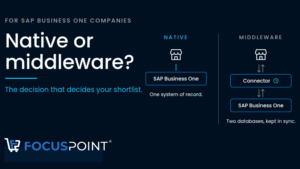
Do we need middleware to connect a portal to SAP Business One?
FocusPoint Ecommerce doesn’t use middleware. FocusPoint Ecommerce is built exclusively for SAP Business One and works directly with SAP Business One data, so account balances, pricing, and order history come from the same system the supplier’s team already uses. Removing the middleware layer means fewer handoffs to maintain and a single source of support.
Getting Started With Customer Data Access in SAP Business One
The best starting point is the questions your team already answers by hand. Before the next seasonal push, pull a week of inbound calls and emails and sort them:
- Balance and invoice questions
- Credit questions ahead of an order
- Price checks on items the buyer already buys
- Reorders of a previous season’s mix
Whatever shows up most often is where self-service pays back first.
Your buyers aren’t going to ask which ERP you run. They’ll notice whether they had to wait. If you’re planning for your next busy season, the FocusPoint team of SAP Business One professionals can walk you through what customer data access would look like on your own SAP Business One data.