Most SAP Business One customers are running a quiet experiment. They have one of the most data-rich ERP platforms available to mid-market companies, packed with customer purchase history, pricing agreements, catalog structure, and order behavior, and they are using it to power a static order portal that looks and functions almost exactly like it did five years ago.
That is not a technology problem. It is a strategy problem, and it is costing revenue every single day.
What an AI-Driven Ecommerce Engine Actually Means for SAP Business One Customers
The phrase “intelligent ecommerce” gets used a lot, often to describe features like product recommendations or a mobile-friendly layout. In practice, it means something more specific and more consequential.
An intelligent ecommerce engine does not just display products and accept orders. It learns from your customers’ behavior, applies your SAP Business One data to personalize every interaction, automates the workflows that your sales and operations teams currently handle manually, and compounds its value over time as it processes more transactions and more signals.
For SAP Business One customers in distribution and manufacturing, this distinction matters enormously. Your ERP already knows which customers buy which products, how often they reorder, what their contract pricing looks like, and where their accounts stand. An intelligent ecommerce engine uses all of that. A generic ecommerce portal ignores most of it.
The Revenue Gap Between SAP B1 Data and Your Digital Commerce Experience
Here is a pattern that appears across distributors, manufacturers, and equipment dealers running SAP Business One. The ERP is configured carefully. Customer pricing tiers are maintained. Product catalogs are organized. Order history goes back years. And yet, the digital commerce experience the company offers its customers reflects almost none of that depth.
The result is a buying experience that feels disconnected from the relationship a customer actually has with the business. A long-standing account logs in and sees the same catalog view as a first-time visitor. A customer who reorders the same 40 SKUs every month has to search for them manually every time. A buyer who qualifies for a negotiated price has to call a rep to confirm it before placing an order.
Every one of these friction points is a revenue leak. Some customers absorb it. Some find a supplier who makes it easier.
This gap exists not because SAP Business One lacks the data, but because most ecommerce platforms were not built to use it. They were built for generic consumer commerce and adapted, imperfectly, for B2B. The integration is an afterthought. The complexity of customer-specific pricing, multi-level approval workflows, and contract catalog structures does not map cleanly onto platforms designed to sell identical products at identical prices to anonymous buyers.
How FocusPoint Ecommerce Transforms SAP Business One into an Intelligent Growth Engine
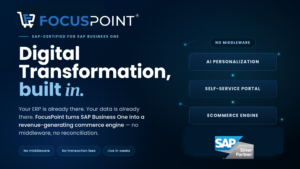
FocusPoint Ecommerce is built exclusively for SAP Business One customers. SAP B1 is not a data source it connects to. It is the foundation the entire ecommerce engine is built on, which changes what is possible.
There is no middleware translating between the ERP and the storefront. Customer-specific catalogs, pricing agreements, and approval workflows are native to the experience, not bolted on. The ecommerce engine uses the same data SAP Business One already maintains, which means the intelligence your business has accumulated over years of customer relationships is immediately available to every digital interaction.
In practice, this looks like a few specific things.
A repeat customer in an industrial distribution environment logs into their self-service portal and sees a personalized catalog built from their purchase history and contract terms. Their most frequently ordered items are surfaced first. The platform flags when they are approaching a reorder threshold based on their historical patterns. Their pricing is already applied, no confirmation call required.
A field service operation running preventative maintenance contracts uses the ecommerce engine to automate parts reordering tied directly to service schedules maintained in SAP. The order workflow routes for approval, then processes, without a sales rep in the loop. The team that used to spend half their week handling routine order requests now handles exception cases instead.
An equipment dealer offers a B2B buyer portal where accounts can configure orders, manage approvals across multiple cost centers, and track order status against their SAP records, all from a mobile interface. The dealer’s average order value increases because the platform surfaces complementary parts and service items based on what that account has purchased before.
These are not feature demonstrations. They are outcomes that follow directly from building ecommerce on top of SAP Business One intelligence rather than alongside it.
Why Generic Ecommerce Platforms Fall Short for Complex B2B and SAP B1 Environments
A standalone platform like Shopify or a generic B2B ecommerce bolt-on can give you a functional storefront. What it cannot give you is a commerce experience grounded in your actual customer relationships, your actual pricing structure, and your actual operational workflows.
Getting there requires integration work that is expensive, fragile, and ongoing. Every time SAP Business One is updated or configured, someone has to verify that the integration still works. Every custom pricing rule requires a workaround. Every approval workflow is an engineering project. The complexity that makes SAP Business One powerful for complex B2B operations becomes the complexity that makes generic ecommerce expensive to maintain.
More importantly, a generic platform will never natively leverage what SAP Business One already knows about your customers. The intelligence stays in the ERP. The ecommerce experience stays generic. And the gap between what your customers experience digitally and what they experience when they call a rep stays wide.
FocusPoint eliminates that gap because it was designed from the ground up for the environment SAP Business One customers actually operate in. Customer-specific pricing is native. Multi-level approvals are native. EDI and punchout are native. Heavy queries run against a separate analytics database so they never slow the storefront. The architecture is built for the complexity, not patched to handle it.
Revenue Growth, Margin Protection, and Competitive Advantage for SAP B1 Distributors and Manufacturers
Treating SAP Business One as the foundation of an intelligent ecommerce engine is a revenue infrastructure decision, not a digital marketing one.
The revenue impact compounds over time. Customers who self-serve order more frequently because friction is removed. Average order values increase because the platform surfaces relevant additions at the moment of purchase intent. Sales reps redirect their time from order entry and pricing confirmation to relationship development and account growth. Operations teams handle fewer manual exceptions. Margin is protected because pricing is applied accurately and consistently, every time, without manual review.
Early-adopter customers in complex B2B environments have seen meaningful lifts in digital order volume, reductions in cost per order, and improvements in customer retention tied directly to the quality of the self-service experience. The specific figures vary by vertical and starting point, but the direction is consistent.
The competitive dynamic is worth naming directly. Buyers in distribution and manufacturing are comparing their experience with your digital channel to the experience they get from larger competitors who have invested in digital commerce infrastructure. If the gap is wide enough, the relationship that took years to build can erode faster than expected. The order portal is no longer sufficient. The companies winning digital commerce in complex B2B are the ones that made it an intelligent growth engine.
A Quick Checklist: Is Your SAP B1 Ecommerce Platform Ready to Scale?
Use these questions to assess where you actually are today.
- Does your ecommerce experience apply customer-specific pricing automatically, without manual confirmation?
- Are repeat customers served personalized catalogs based on their purchase history?
- Can customers self-serve order approvals through multi-level workflows without calling a rep?
- Are routine reorders automated or prompted by purchasing pattern intelligence?
- Does your digital channel surface complementary products based on account-level behavior?
- Can your operations team see ecommerce order status within SAP Business One without a separate sync?
- Are heavy analytics queries separated from storefront performance so neither slows the other?
If more than two of these are “no” or “not sure,” you are leaving revenue on the table that your SAP Business One data could already be generating.
Frequently Asked Questions
Does FocusPoint Ecommerce require custom development to connect to SAP Business One? No. FocusPoint Ecommerce is built natively on SAP Business One, which means there is no middleware required and no custom integration to maintain. The connection to your SAP data is foundational, not an add-on.
Can FocusPoint handle customer-specific pricing and catalog structures? Yes. Customer-specific catalogs, contract pricing tiers, and account-level configurations are native to the platform. This is one of the core reasons FocusPoint exists: generic platforms were not designed for this level of B2B complexity.
How long does FocusPoint Ecommerce take to deploy? Deployment is measured in weeks, not months. Because the platform is purpose-built for SAP Business One, the configuration process is significantly faster than implementing a generic platform and attempting to integrate it with your ERP.
Is FocusPoint Ecommerce suitable for companies with both B2B and B2C operations? Yes. The platform supports mixed B2B and B2C environments, including industrial distributors and dealers who serve both account-based buyers and direct consumers.
What does FocusPoint Ecommerce cost? FocusPoint Ecommerce is a monthly subscription based on the modules your business uses. There is no implementation fee and no transaction fee, which means cost scales with the value you are generating, not the volume of transactions you process.
How does FocusPoint handle mobile ecommerce for field-based buyers? Mobile ecommerce is a native capability, not a responsive afterthought. Field-based buyers, technicians, and purchasing contacts can access their full self-service portal from any device with the same intelligence and permissions they have on desktop.
The Strategic Decision in Front of SAP Business One Companies
The order portal served a purpose. It digitized a transaction that used to require a phone call or a fax. For a period of time, that was competitive differentiation.
That period has ended.
The SAP Business One customers who are growing their digital revenue share are the ones who made a decision to treat ecommerce as a core growth infrastructure, not a customer convenience feature. They are using the intelligence their ERP already contains to personalize buying experiences, automate operational workflows, and compound customer loyalty over time.
The data is already there. The question is whether your ecommerce engine is intelligent enough to use it.
If you want to understand what that looks like for your specific operation, the most useful next step is a direct conversation. Schedule a Consultation with the FocusPoint team and we will show you exactly what is possible within your SAP Business One environment.