Most SAP Business One distributors and manufacturers don’t set out to build a fragile ecommerce stack. They make a reasonable decision at a point in time, usually choosing a platform that “integrates with SAP,” and move forward. Two years later, their IT team is managing a brittle connector, their order data is running 20 minutes behind, and their ecommerce growth has hit a ceiling nobody can quite explain.
This is the connector problem. And in 2026, it’s more common than ever.
What Connector-Based Ecommerce Means for SAP Business One Users
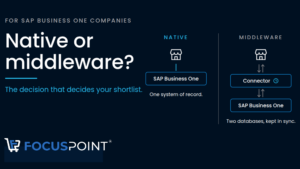
Connector-based ecommerce, often called bolt-on or middleware ecommerce, means your storefront lives in one system and your ERP lives in another. A third-party integration layer sits between them, periodically pushing and pulling data: orders, products, pricing, customer accounts, inventory status.
On paper, this works. In practice, it creates a permanent seam in your business.
The Appeal of the Bolt-On Approach
The appeal is understandable. Generic ecommerce platforms are mature, visually polished, and quick to demo well. Your team can launch a storefront without waiting on an ERP-native build. For companies without complex B2B requirements, this path is sometimes reasonable.
But most SAP Business One customers are not simple. They carry customer-specific pricing, contract-based catalogs, complex approval workflows, branch-level inventory logic, and sales rep structures that don’t map cleanly to a generic platform’s data model. The connector has to handle all of that translation. And it rarely handles it well.
Where Connectors Create Structural Friction
The seam shows up in predictable places. Order confirmations that reflect stale pricing. Customer accounts that show the wrong credit terms. Product catalog updates that lag behind SAP by hours. Approval workflows that exist in SAP but don’t surface to the buyer. Returns and credits that require manual reconciliation.
Each of these is a small failure. Collectively, they erode the customer experience your ecommerce investment was supposed to improve.
The Real Cost of the Middleware Layer
The licensing cost of a connector is usually modest. The operational cost is not.
Data Sync Delays and Order Accuracy
A mid-sized industrial distributor running a connector-based platform might process 400 to 600 orders per day across sales channels. If pricing or catalog data is out of sync even 2% of the time, that’s 8 to 12 orders per day requiring manual intervention. At 10 minutes per correction, that’s roughly an hour and a half of operational drag every single day, compounding across your customer service team.
This is not a technology problem. It is a structural one. The connector was never meant to carry the weight of a complex B2B operation.
Version Lock and Upgrade Risk
Every SAP Business One upgrade, every platform update, every API deprecation is a potential breaking event in a connector-dependent architecture. IT teams in mid-market distribution companies describe this as the “upgrade anxiety” problem: the fear of touching anything because it might break the ecommerce layer.
That fear has a cost. It delays SAP upgrades. It freezes feature development. It concentrates risk in a single integration layer that no one fully owns.
What SAP Business One Native Ecommerce Delivers
When ecommerce is built natively on SAP Business One, the seam disappears. There is no middleware, no sync cycle, no translation layer. The ecommerce engine reads and writes directly to SAP, because SAP is the system of record and the commerce platform share the same foundation.
SAP as the Revenue Engine, Not a Data Feed
FocusPoint Ecommerce treats SAP Business One as the growth infrastructure, not just a backend data source. Customer-specific pricing, contract catalogs, approval workflows, and account hierarchies don’t need to be replicated in a separate system. They exist once, in SAP, and the ecommerce experience reflects them in full.
For a heavy equipment distributor managing hundreds of account-specific pricing agreements, this is the difference between an ecommerce channel that actually works and one that requires constant exception handling. For an electrical wholesaler running a hybrid B2B/B2C storefront, it means the industrial account customer and the contractor on the same platform see exactly what they’re supposed to see, without manual configuration on either side.
AI-Powered Workflows Without Added Complexity
Native SAP ecommerce also means AI capabilities can be grounded in real operational data. Predictive ordering draws on actual purchase history. Personalized search and product recommendations reflect what each customer actually buys, at what frequency, under which contract terms. Workflow automation triggers based on real SAP logic, not an approximation of it.
This is the difference between AI as a feature and AI as a growth driver.
The Architecture Difference That Compounds Over Time
The native vs. connector decision looks like a technology choice. Over three to five years, it becomes a strategic one.
Connector-based architectures accumulate debt. Each new integration adds another failure point. Each platform upgrade creates new reconciliation work. The ecommerce stack that started as a six-month project becomes a permanent maintenance burden.
Native architectures compound. Each improvement to the SAP foundation improves the ecommerce experience automatically. Customer data gets richer. AI models get sharper. Operational workflows become more automated. The platform earns its keep every quarter, not just at launch.
For SAP Business One customers in distribution and manufacturing, the compounding effect of a native ecommerce foundation is one of the most underappreciated strategic advantages available. FocusPoint Ecommerce is deployed in weeks, not months, with no implementation fee and no transaction fees, on a monthly subscription based on modules utilized.
How to Evaluate Your Current Ecommerce Setup
If you’re running connector-based ecommerce today, these questions will tell you how much it’s costing you:
- How many orders per week require manual correction due to pricing or catalog sync errors?
- How long does it take for a SAP catalog update to reflect on your storefront?
- Can your approval workflows in SAP be enforced at the point of online ordering?
- How much IT time per month is spent maintaining the integration layer?
- Has connector maintenance delayed a SAP upgrade in the past 18 months?
- Can your ecommerce platform surface customer-specific contract pricing without custom development?
- Do your sales reps have visibility into what their accounts ordered online?
If more than two of these produce uncomfortable answers, the connector is limiting your growth ceiling, not just your IT team’s Friday afternoons.
Frequently Asked Questions
What is connector-based ecommerce for SAP Business One? Connector-based ecommerce uses a middleware layer to link a separate storefront platform to SAP Business One. Data such as orders, pricing, and catalog updates syncs between the two systems on a scheduled or triggered basis. This architecture creates ongoing data latency, version risk, and operational complexity in B2B environments with customer-specific pricing or complex workflows.
Why is native SAP ecommerce better for distributors and manufacturers? Native SAP ecommerce eliminates the middleware layer entirely. The ecommerce engine operates directly within SAP Business One, meaning customer-specific pricing, approvals, catalogs, and order logic are enforced at the point of the transaction without sync delays or reconciliation overhead. This reduces operational drag and allows AI-driven capabilities to draw on full, accurate SAP data.
What are the hidden costs of ecommerce connectors? Beyond licensing fees, connector-based ecommerce creates costs in manual order correction, IT maintenance hours, delayed SAP upgrades due to integration risk, and customer experience failures caused by stale data. For mid-market distributors, these operational costs frequently exceed the savings from choosing a lower-cost generic platform.
How does FocusPoint Ecommerce connect to SAP Business One? FocusPoint Ecommerce is built natively on SAP Business One with no middleware. It reads and writes directly to SAP, treating your ERP as the single source of truth for all commerce operations, pricing, customer data, and workflow logic. There is no separate sync process, no connector to maintain, and no data translation layer.
How long does a FocusPoint Ecommerce deployment take? FocusPoint Ecommerce is designed for fast deployment, typically measured in weeks rather than months. There is no implementation fee. Pricing is a monthly subscription based on modules utilized, with no transaction fees.
The choice between native and connector-based ecommerce for SAP Business One is not really about features. It’s about whether your ecommerce channel compounds or costs over time.
If you’re ready to see what a native SAP ecommerce architecture looks like for your specific operation, including your pricing complexity, your catalog structure, and your customer experience goals, schedule a consultation with the FocusPoint team. The conversation starts with your business, not a product demo.