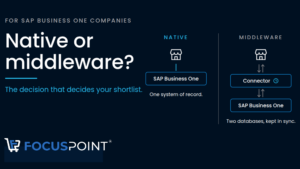
Most SAP Business One customers don’t set out to build a middleware problem. It happens gradually. A CRM gets connected here. A marketing platform gets patched in there. An ecommerce front end gets bolted on with a third-party connector. Each addition seems reasonable at the time. Then, one day, you have five systems that technically “talk to each other” and a business that can’t agree on a single number.
That’s the middleware trap. And for distributors, manufacturers, and complex B2B operators, it’s one of the most persistent constraints on growth that rarely gets named as such.
What Middleware Actually Costs B2B Companies
The obvious costs show up in IT budgets. Licensing fees for connectors. Maintenance contracts. The internal hours spent troubleshooting sync failures, reconciling mismatched data, and managing vendor relationships across systems that were never designed to work together.
The less obvious costs are harder to see, and far more expensive. When your ecommerce platform doesn’t share a common data layer with SAP Business One, customer-specific pricing breaks down. Order workflows fragment. Approvals that should be automatic become manual. Your sales team fills gaps that technology should handle.
For executives, the cost shows up differently. A CFO who can’t confirm whether a closed-won deal was ever invoiced isn’t making a decision. She’s making an educated guess. A CMO who can’t connect campaign spend to closed revenue isn’t optimizing marketing. He’s defending a budget he can’t fully justify. These are growth constraints that happen to surface as technology problems.
Middleware doesn’t just slow systems down. It dilutes the quality of every decision made above it.
Why “Good Enough” Integration Isn’t Enough Anymore
There’s a version of middleware that used to be acceptable. You synced orders nightly. Pricing updated weekly. Reports were pulled manually and assembled into a spreadsheet before the Monday meeting. For a while, the business grew anyway.
That version of acceptable is gone. B2B buyers now expect the kind of self-service experience, personalized pricing, and order accuracy that only a deeply integrated ecommerce engine can deliver. Your largest accounts are evaluating your digital experience the same way they evaluate your product quality. If the buying process is slow, inconsistent, or manual, they notice.
At the executive level, the expectation has shifted equally fast. Boards want clean attribution from marketing spend to revenue. CFOs want to close the gap between pipeline and cash. COOs want operational throughput data that doesn’t require a three-day analyst sprint to produce. None of that is possible when data is scattered across middleware-dependent systems with no common semantic layer.
The companies pulling ahead aren’t the ones with the most integrations. They’re the ones who eliminated the need for them.
The No-Middleware Architecture and What It Changes
FocusPoint is built on a single architectural principle: SAP Business One is the source of truth, and everything connects to it directly. FocusPoint uses no middleware, no patchwork connectors, and no third-party sync layer that could introduce latency, data drift, or version conflicts.
What that means in practice is worth spelling out.
FocusPoint Ecommerce runs natively against SAP Business One data. Customer-specific catalogs, pricing tiers, approval workflows, and order logic all draw from the same data your operations team works from every day. A customer logging into the self-service portal sees their actual contract pricing. An order placed at 9 PM processes against live business logic, not a cached snapshot from the night before. Complex workflows (multi-location orders, parts-plus-labor combinations, rental configurations) execute without manual intervention because the ecommerce engine and the ERP are not two separate systems that happen to be connected. They are one system.
FocusPoint Nexus operates on the same architectural foundation, extended across every revenue surface the business runs. CRM, call-tracking, EDI, punchout, paid channels, web, and SAP all converge into a single knowledge graph grounded in the company’s own taxonomy and ontology. When a CFO asks a plain-English question about revenue leakage, the answer comes back with a confidence signal attached. When a CRO wants to know which deals have been stuck for more than three weeks, the answer doesn’t require a ticket to the data team. It’s available in seconds, drawn from a unified data layer that no middleware layer can distort.
This is what eliminating middleware actually buys you. Decisions are grounded in clean data. Ecommerce operations run without manual correction. Executive intelligence compounds over time rather than degrading as systems drift apart.
The Revenue Leakage No One Talks About
One specific consequence of middleware-dependent architectures deserves its own attention: closed-won deals that never get invoiced.
It happens more than most finance teams want to admit. A deal closes in the CRM. The handoff to ERP requires a manual step, or a sync that failed silently, or a workflow that wasn’t configured for that deal type. The invoice never generates. The revenue never posts. Nobody catches it until a reconciliation cycle weeks later, and sometimes it isn’t caught at all.
FocusPoint Nexus Finance module is built specifically to surface this kind of revenue leakage. It compares closed-won status in the CRM against invoice and payment records in SAP Business One, flags the gaps, and surfaces them to the CFO without requiring anyone to run a manual audit. For companies with active pipelines and complex deal structures, the recovered revenue from this single capability can represent a meaningful return on the platform investment.
This is the kind of outcome that middleware architectures structurally cannot deliver. The gap exists because the systems don’t share a common data layer. Closing it requires eliminating the gap, not patching it.
What the Shift Looks Like for Your Ecommerce Operation
For distributors and manufacturers running ecommerce on top of SAP Business One, the middleware problem shows up most visibly in the buying experience. A customer who places a large order through your portal shouldn’t have to wait for a rep to confirm pricing. A returning account placing a repeat order shouldn’t have to re-enter information your ERP already holds. A field service customer ordering replacement parts at 7 AM shouldn’t hit a wall because the sync hasn’t run yet.
FocusPoint Ecommerce removes those friction points by treating ecommerce not as a channel layered on top of SAP, but as a revenue engine running within it. AI-powered personalization and search draw from SAP-native data. Predictive ordering surfaces reorder suggestions based on actual purchase history. Self-service portals give accounts the autonomy they want without creating operational gaps your team has to fill manually.
The result is a higher average order value, a lower cost to serve, and a digital channel that generates revenue without requiring a headcount increase to support it.
Choosing the Right Architecture Before You Scale
The companies that feel this most acutely are the ones that are growing. A middleware architecture that was manageable at $20M in revenue becomes genuinely painful at $75M. More customers, more SKUs, more deal complexity, more reporting requirements — and every one of those adds load to a system architecture that wasn’t designed to carry it.
The right time to address the architecture is before the scale, not after. Rearchitecting under growth pressure is expensive, disruptive, and slow. Deploying FocusPoint before the pressure arrives means the ecommerce engine, the executive intelligence layer, and the SAP foundation all scale together without requiring a re-platforming project at the worst possible moment.
FocusPoint deploys in weeks, not months. There’s no implementation fee for the ecommerce platform, no transaction fees, and the monthly subscription scales with the modules your business actually uses. For Nexus, the outcome-aligned option available to select strategic accounts ties a portion of the pricing to revenue leakage recovered in year one. That’s not a feature pitch. It’s confidence in what the architecture delivers.
If your current setup requires middleware to function, it’s worth asking what that architecture is costing you — in revenue, in decisions, and in the growth you’re not capturing yet. Schedule a consultation with the FocusPoint team to see what a no-middleware architecture built on SAP Business One looks like for your operation.
Frequently Asked Questions
What is middleware in the context of SAP Business One? Middleware refers to any third-party connector, sync layer, or integration platform used to pass data between SAP Business One and other systems such as a CRM, ecommerce platform, or marketing tool. While middleware can establish connectivity, it introduces latency, data drift, sync failures, and points of failure that compound as the business grows and adds more connected systems.
Why does middleware create revenue leakage? Revenue leakage occurs when data doesn’t transfer cleanly between systems. A common example is a deal that closes in a CRM but never generates an invoice in the ERP because the middleware sync failed silently or a workflow wasn’t configured for that deal type. Without a shared data layer, these gaps are difficult to detect and often go unrecovered for weeks or longer.
How does FocusPoint eliminate the middleware problem? FocusPoint is built natively on SAP Business One as the single source of truth. Both FocusPoint Ecommerce and FocusPoint Nexus connect directly to SAP data without requiring a third-party sync layer. This means ecommerce operations, executive intelligence, and operational workflows all draw from the same data in real time, eliminating the drift, latency, and reconciliation failures that middleware architectures produce.
What is the business impact of removing middleware from a B2B ecommerce operation? Removing middleware from a B2B ecommerce operation directly improves order accuracy, reduces manual intervention in complex workflows, and ensures that customer-specific pricing and catalog logic execute correctly at the point of purchase. The downstream effect is a higher average order value, lower cost to serve, and a digital channel that scales without requiring proportional increases in operational headcount.
Is FocusPoint only relevant for large SAP Business One customers? FocusPoint is designed for SAP Business One customers across the $5M to $500M revenue range, including distributors, manufacturers, equipment dealers, and industrial wholesalers. The platform is particularly well-suited for companies with complex B2B pricing, multi-channel sales, or executive intelligence needs that generic ecommerce or BI tools cannot address.
Schedule a consultation to learn more about the FocusPoint solution.