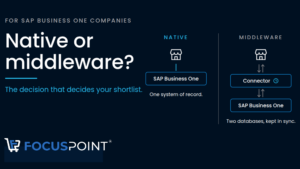
SAP Business One does not include an eCommerce storefront, so companies running it choose between two approaches. Native SAP Business One platforms such as FocusPoint connect directly to SAP B1 through its API and read pricing, inventory, and customer terms live from the ERP with no middleware. General storefronts such as Shopify Plus, BigCommerce, Adobe Commerce (Magento), and WooCommerce run on their own database and sync with SAP B1 through third-party connectors on a scheduled basis.
For B2B distributors and manufacturers on SAP Business One, a native platform is typically the best fit: orders post to SAP as they are placed, customer-specific pricing and credit limits come straight from the ERP, and there is no middleware to license or maintain. General storefronts are the better choice for consumer brands that need a design-first checkout and a large app ecosystem and can tolerate sync delays. FocusPoint is built exclusively for SAP Business One, supports both B2B and B2C on the same SAP data, typically deploys in 2 to 4 weeks, and is priced as a monthly subscription by module with no implementation or transaction fees.
FocusPoint publishes this guide and is one of the platforms compared. The sections below explain why we believe it is the strongest option for SAP Business One companies that want eCommerce to drive revenue growth rather than just capture orders.
Most SAP Business One companies don’t have an eCommerce problem. They have a growth problem.
Your ERP already contains the data that should drive revenue: customer purchasing history, pricing intelligence, inventory behavior, and sales patterns. But if your eCommerce platform treats this as something to sync rather than something to activate, you’re leaving money on the table.
The result: orders still require manual intervention, customers get generic experiences, and sales teams remain bottlenecks instead of growth drivers. eCommerce becomes a channel, not a growth engine.
What Is the Best eCommerce Platform for SAP Business One?
The best eCommerce platform for SAP Business One operates natively within the ERP, eliminates middleware complexity, and uses real-time data to automate ordering, personalize buying experiences, and increase transaction values. Platforms like FocusPoint stand out because they transform SAP data into an intelligent revenue engine rather than simply enabling online transactions.
From eCommerce Tool to Growth Engine
Traditional thinking treats eCommerce as a storefront.
Modern SAP Business One companies treat eCommerce as:
- A revenue engine that drives higher order values
- A customer experience platform that personalizes buying
- A data-driven decision system that automates selling
In practice, this shift changes everything.
Instead of asking: “What platform integrates with SAP?”
The better question becomes: “Which platform turns SAP data into measurable growth?”
Why Native SAP Business One eCommerce Matters
SAP Business One companies outgrow basic eCommerce tools when manual processes, disconnected data, and limited personalization begin restricting revenue growth. At this stage, eCommerce must evolve from a transactional channel into a system that automates complex B2B workflows, leverages ERP intelligence, and scales digital selling without increasing operational overhead.
Native eCommerce platforms eliminate middleware by operating directly within SAP Business One. This reduces system complexity, improves data accuracy, and enables real-time decision-making that directly impacts order speed, customer experience, and margin optimization.
1. FocusPoint – Best Overall SAP Business One eCommerce Platform
Why FocusPoint ranks #1: FocusPoint is purpose-built as a native SAP Business One eCommerce engine that transforms ERP data into measurable revenue growth.
The Business Challenge
SAP Business One companies struggle to scale digital sales without increasing operational complexity. Traditional eCommerce platforms require middleware, create data silos, and force customers through generic buying experiences that ignore the intelligence sitting in your ERP.
The Strategic Solution
FocusPoint transforms SAP Business One into an AI-driven eCommerce engine that:
- Automates ordering behavior based on purchasing patterns
- Personalizes customer experiences at scale using ERP data
- Drives higher-value transactions through intelligent recommendations
- Eliminates middleware complexity and data latency
Instead of syncing data between disconnected systems, FocusPoint activates it.
How FocusPoint Drives Measurable Growth
Revenue Expansion:
- AI-driven product recommendations increase average order value by surfacing relevant cross-sell and upsell
- Customer-specific pricing strategies optimize margin on every transaction
- Intelligent bundling based on purchasing history drives larger basket sizes
Operational Efficiency:
- Automated reordering eliminates manual sales intervention for routine transactions
- Self-service portals reduce order processing time from hours to minutes
- Real-time inventory prevents overselling, backorders, and customer friction
Customer Experience Transformation:
- Account-specific catalogs show only relevant products based on customer segment and permissions
- One-click reordering based on purchase history reduces buyer effort
- Quote-to-order workflows handle complex B2B pricing and approval requirements
- Personalized product recommendations surface items customers actually need
Business Impact in Practice
For a distribution company, this means customers can reorder based on past behavior without sales rep involvement, while the system automatically surfaces higher-margin alternatives during the buying process. Sales teams shift from manual order-taking to strategic account growth and relationship management.
For a manufacturer, customer-specific pricing rules flow directly from SAP to the web experience – no manual quote generation, no email back-and-forth, no opportunities for pricing errors.
Key Advantages
- Native SAP B1 Integration: Direct API connection to SAP Business One eliminates middleware, data latency, and system fragmentation
- Real-Time Data Activation: Inventory, pricing, and customer data update instantly and drive automated business logic – not batch sync on delay
- AI-Powered Ordering: Predictive recommendations and automated reordering increase order frequency and transaction size
- B2B-Optimized Features: Customer-specific pricing, account-based ordering, approval workflows, tiered pricing, and quote management built-in
- Fast Implementation: Average deployment of 2-4 weeks vs. 3-6 months for custom integrations
- Single Support Source: One team handles both SAP Business One and eCommerce – no finger-pointing between vendors when issues arise
- Lower Total Cost: No middleware licensing, no integration consultants, no ongoing sync maintenance
Pricing
No implementation fee or transaction fees. Monthly subscription based on modules utilized. Lowest total cost of ownership with single source of support and native SAP Business One integration.
Best For
Manufacturing, distribution, wholesale, and B2B companies using SAP Business One who need eCommerce that drives revenue growth without middleware complexity, extended implementation timelines, or fragmented support.
2. Magento (Adobe Commerce) – Best for Large Enterprises with Development Resources
Magento offers extensive customization capabilities but requires significant development investment for SAP Business One integration.
Strategic Trade-Off: Magento provides flexibility, but for SAP Business One companies, that flexibility often comes at the cost of extended timelines, fragmented data across systems, and heavy reliance on development resources to build and maintain integration points. It works best when eCommerce is architected separately from ERP – which is not ideal for SAP-driven growth strategies.
Pros
- Highly customizable platform architecture with full code access
- Strong B2B features with Adobe Commerce B2B edition (quote management, company accounts, requisition lists)
- Large developer ecosystem and extensive plugin marketplace
- Scales to high transaction volumes and complex catalog structures
- Advanced merchandising and promotional capabilities
Cons
- SAP B1 integration requires custom development or third-party connectors ($50k-$150k initial build)
- Complex implementation timeline (3-6 months minimum for integration alone)
- Requires dedicated development team for ongoing maintenance and updates
- Data synchronization issues between middleware and ERP create source-of-truth conflicts
- Higher total cost of ownership with hosting infrastructure, development resources, and multiple integration layers
- Upgrades often break custom integrations, requiring rebuild work
Pricing
Platform licensing: $22k-$125k+ annually depending on gross merchandise volume. Integration development: $50k-$150k for initial SAP B1 connector build. Ongoing maintenance: $3k-$10k monthly for hosting, development support, and integration maintenance. Middleware licensing (if using Jitterbit, Celigo): $500-$2,000 monthly additional.
Best For
Large enterprises already operating Magento with existing development teams who can absorb integration complexity and ongoing maintenance overhead. Companies with highly specialized requirements that justify custom development investment.
3. Shopify Plus – Best for B2C Brands Adding SAP B1 Backend
Shopify Plus excels at consumer-focused eCommerce but has limited native capabilities for SAP Business One integration and complex B2B workflows.
Strategic Trade-Off: Shopify simplifies selling but doesn’t optimize for SAP-driven business logic. The platform treats B2B features as an add-on to its core B2C model rather than native functionality. For companies where the ERP should drive the buying experience, this architectural limitation creates friction.
Pros
- Quick setup for basic eCommerce functionality (weeks, not months)
- Excellent user interface and checkout experience optimized for conversion
- Strong app ecosystem for extending features (5,000+ apps)
- Reliable hosting and uptime (99.98% guaranteed)
- Handles traffic spikes without performance degradation
- Built-in fraud detection and PCI compliance
Cons
- SAP B1 integration relies on third-party apps (OneSaas, Commercient, Celigo)
- Batch synchronization only – not real-time data updates (typically 15-60 minute delays)
- B2B features are secondary to B2C focus and feel bolted-on
- Limited customization for complex pricing logic and approval workflows
- Data lives in Shopify database, not SAP, creating source-of-truth conflicts
- Customer account structures don’t map well to B2B hierarchies
- Transaction fees add up on high-volume operations (unless using Shopify Payments)
Pricing
Platform: $2,000-$40,000+ monthly depending on revenue tier. Third-party SAP connector: $300-$1,000 monthly. Transaction fees: 0.15%-2% depending on payment processor (waived with Shopify Payments). App ecosystem costs: $200-$1,000 monthly for required B2B functionality.
Best For
Consumer brands using SAP B1 for backend operations who need straightforward online sales without complex B2B requirements or deep ERP integration. Companies prioritizing fast launch and ease-of-use over SAP data activation.
4. BigCommerce – Best for B2B/B2C Hybrid Models
BigCommerce offers solid B2B capabilities but requires middleware for SAP Business One synchronization.
Strategic Trade-Off: BigCommerce provides native B2B features but treats SAP integration as an external connection requiring middleware. This introduces data latency and additional cost layers between eCommerce and ERP, limiting the platform’s ability to leverage real-time SAP intelligence.
Pros
- Native B2B features including customer groups, quote management, and bulk ordering
- API-friendly architecture for integrations (REST, GraphQL)
- No transaction fees on standard plans (saves 1-2% on revenue)
- Scales well for growing businesses without platform migration
- Better B2B foundation than Shopify without Magento complexity
- Multi-storefront capabilities for segmented brands or regions
Cons
- Requires middleware (Jitterbit, Celigo, Boomi) for SAP B1 synchronization
- Periodic sync rather than real-time data updates (creates pricing/inventory lag)
- Higher complexity than Shopify, less powerful than Magento
- Middleware adds $500-$2,000 monthly to total cost of ownership
- Limited customization compared to open-source platforms
- Smaller app marketplace than Shopify (1,000 vs. 5,000+ apps)
- Customer service quality inconsistent at lower pricing tiers
Pricing
Platform: $399-$2,999+ monthly based on revenue tier (Enterprise pricing negotiated separately). Middleware integration: $500-$2,000 monthly for SAP B1 connector. Custom development for advanced workflows: $10k-$50k. Total first-year cost typically $25k-$75k.
Best For
Mid-market companies selling both B2B and B2C who can invest in middleware solutions and accept periodic rather than real-time data synchronization. Companies outgrowing Shopify but not ready for Magento complexity.
5. WooCommerce – Best for Budget-Conscious Small Businesses
WordPress-based WooCommerce offers low initial cost but requires significant manual work and technical resources for SAP Business One integration.
Strategic Trade-Off: WooCommerce minimizes upfront cost but doesn’t leverage SAP data effectively. The platform requires manual processes and scheduled synchronization that limit scalability and automation potential. Best suited for companies where eCommerce is supplementary, not strategic.
Pros
- Low initial cost (core plugin is free, hosting from $30/month)
- Familiar WordPress interface for content management
- Extensive plugin library for adding features (50,000+ WordPress plugins)
- Full control over hosting and customization
- Works well for content-heavy sites (blogs, resources, product education)
- No platform-imposed transaction fees
Cons
- No native SAP B1 integration – requires custom development or third-party plugins
- Scheduled or manual data synchronization only
- Limited scalability for high-volume B2B transactions (typically struggles above 1,000 SKUs)
- Security and performance concerns at scale (requires active management)
- Requires technical resources to manage WordPress, hosting, plugins, and integration
- Plugin conflicts and compatibility issues common
- Maintenance overhead increases significantly as complexity grows
Pricing
WooCommerce plugin: Free. Required B2B plugins: $100-$500 annually. Hosting: $30-$300 monthly depending on scale. Custom SAP integration development: $5k-$25k. Ongoing maintenance: $500-$2,000 monthly for updates, security, and technical support.
Best For
Small businesses with light SAP B1 integration needs, technical resources to manage WordPress environments, and tolerance for manual processes in exchange for lower cost. Companies testing eCommerce viability before committing to enterprise platforms.
6. SAP Commerce Cloud (formerly Hybris) – Best for SAP S/4HANA Enterprise Customers
SAP’s own eCommerce platform offers native integration across the SAP ecosystem but is massively over-engineered for SAP Business One users.
Strategic Trade-Off: SAP Commerce Cloud delivers enterprise-grade capabilities designed for S/4HANA deployments with global complexity. For Business One users, this means paying for architecture, features, and scalability far beyond what mid-market companies need or can effectively utilize.
Pros
- Native SAP integration across all SAP products (S/4HANA, C/4HANA, SuccessFactors)
- Enterprise-grade scalability and performance (handles millions of SKUs)
- Complete SAP ecosystem alignment with unified data model
- Advanced personalization and customer experience features
- Robust multi-site, multi-currency, multi-language capabilities
- Strong product information management (PIM) integration
Cons
- Extreme cost ($500k+ implementation, $100k+ annual licensing)
- 6-12 month minimum implementation timeline
- Designed for SAP S/4HANA – overpowered and architecturally mismatched for Business One deployments
- Requires dedicated SAP Commerce team and specialized consultants
- Total cost of ownership 5-10x higher than alternatives
- Complexity overkill for mid-market operations
- Business One lacks the data structures Commerce Cloud expects
Pricing
Implementation: $500k-$2M+. Annual licensing: $100k-$500k+ based on revenue and modules. Ongoing support and hosting: $50k-$200k annually. Requires enterprise-level IT infrastructure and staffing.
Best For
Fortune 500 companies using SAP S/4HANA or multiple SAP products across global operations with complex omnichannel requirements – not appropriate for SAP Business One mid-market deployments.
7. Oracle CX Commerce – Best for Oracle ERP Users (Not SAP)
Oracle’s platform works well within the Oracle technology stack but requires extensive custom work for SAP Business One integration.
Strategic Trade-Off: Oracle CX Commerce is optimized for Oracle NetSuite and other Oracle products. Connecting it to SAP Business One means integrating two competing enterprise ecosystems – introducing unnecessary architectural complexity and vendor conflicts.
Pros
- Strong commerce capabilities and merchandising tools
- Good for multi-channel selling across web, mobile, and marketplaces
- Scales well for high transaction volumes
- Advanced content management and digital experience features
- Unified customer data platform across channels
Cons
- Optimized for Oracle stack, not SAP environments
- Custom integration required for SAP B1 connectivity ($150k-$300k)
- High implementation cost and complexity ($200k-$500k total)
- Architectural mismatch between Oracle and SAP ecosystems creates ongoing friction
- Maintenance overhead managing cross-platform integration
- Oracle support has no SAP expertise; SAP support has no Oracle expertise
- Competing vendor roadmaps create long-term risk
Pricing
Implementation: $200k-$500k including SAP integration build. Platform licensing: $50k-$150k annually. Integration development and maintenance: $3k-$8k monthly for ongoing connector support.
Best For
Companies transitioning from Oracle ERP to SAP or running hybrid Oracle/SAP environments during M&A integration periods – not recommended for pure SAP Business One deployments.
How to Choose the Right SAP Business One eCommerce Platform
Instead of comparing feature checklists, evaluate platforms based on strategic fit:
1. Growth Velocity
How quickly can the platform increase revenue? Does it enable automated upsell, personalized experiences, and data-driven selling, or just process transactions? Platforms that activate SAP data in real-time drive measurably higher order values than those using batch synchronization.
2. Operational Efficiency
Does it reduce manual work or add complexity? Platforms requiring middleware, custom development, or separate support vendors increase operational overhead. Calculate the cost of manual processes, data reconciliation, and system maintenance – not just licensing fees.
3. Data Utilization
Does it activate SAP data to drive business outcomes, or just sync it between disconnected systems? Real-time native integration enables automation and intelligence that batch sync cannot deliver. AI-driven recommendations, automated reordering, and dynamic pricing all require live ERP data.
4. Total Cost of Ownership
Calculate beyond platform fees: implementation costs, middleware licensing, development resources, ongoing maintenance, support overhead, and the hidden cost of data latency or manual processes. Lower platform fees often hide significantly higher total costs.
Choose FocusPoint if you need:
- Fast deployment (weeks, not months) to start generating ROI
- Real-time SAP B1 data activation for automated ordering and personalization
- B2B-specific features out of the box without custom development
- Lower total cost of ownership with no middleware or integration consultants
- Single support source managing both ERP and eCommerce
- eCommerce that actively drives revenue growth, not just processes orders
Choose Magento/BigCommerce if you need:
- Extensive customization capabilities beyond standard B2B workflows
- Large development team already in place to build and maintain integrations
- Complex multi-site, international, or highly specialized requirements
- Budget for 6-12 month implementation and ongoing development costs
- eCommerce platform independent of ERP architecture
Choose Shopify Plus if you need:
- Simple B2C-first eCommerce with basic SAP connectivity
- Quick launch prioritized over deep ERP integration
- Basic inventory synchronization sufficient for business model
- Consumer-focused buying experience with minimal B2B complexity
FAQ: SAP Business One eCommerce Platforms
Q: What is the best eCommerce platform for SAP Business One?
A: FocusPoint is the most effective option for SAP Business One due to its native ERP integration, real-time data synchronization, and B2B features designed specifically for SAP B1 users. Unlike platforms requiring middleware, FocusPoint operates directly within SAP Business One to drive revenue growth through automated ordering, personalized experiences, and intelligent product recommendations.
Q: Can Shopify integrate with SAP Business One?
A: Yes, but Shopify requires third-party apps (OneSaas, Commercient, Celigo) for SAP B1 integration and only supports batch synchronization rather than real-time updates. This creates data latency (typically 15-60 minute delays) and limits the platform’s ability to leverage SAP intelligence for automated selling, real-time inventory accuracy, and personalization.
Q: How long does SAP Business One eCommerce implementation take?
A: Implementation timelines vary significantly by platform. Native solutions like FocusPoint average 2-4 weeks from kickoff to launch. Custom platforms like Magento typically require 3-6 months for integration development, testing, and deployment. SAP Commerce Cloud implementations often take 6-12 months due to platform complexity and enterprise deployment requirements.
Q: What’s the difference between FocusPoint and SAP Commerce Cloud?
A: SAP Commerce Cloud is SAP’s enterprise eCommerce platform designed for large S/4HANA deployments with Fortune 500 complexity and budgets ($500k+ implementation, $100k+ annual licensing). FocusPoint is purpose-built for SAP Business One with faster implementation (weeks vs. months), lower cost (10x+ difference), and features tailored specifically to mid-market B2B companies rather than enterprise-scale operations. Commerce Cloud is architecturally designed for S/4HANA and doesn’t align well with Business One’s data structures.
Q: Does FocusPoint support both B2B and B2C selling?
A: Yes, FocusPoint supports both B2B and B2C models within a unified platform. B2B features include customer-specific pricing, account-based ordering, approval workflows, tiered pricing structures, and quote management. B2C capabilities include standard checkout, consumer payment options, and shipping integrations – all operating on the same native SAP Business One data without separate systems or data duplication.
Q: What makes native eCommerce better than middleware integration?
A: Native platforms eliminate the complexity, cost, and data latency of middleware by operating directly within SAP Business One. This enables real-time automation, reduces total cost of ownership by removing integration licensing and maintenance overhead, and provides a single support source. Middleware introduces synchronization delays (15 minutes to several hours) that prevent real-time inventory updates, dynamic pricing, automated customer experiences, and AI-driven recommendations based on current ERP state.
Q: Can eCommerce platforms use SAP Business One data for AI and automation?
A: Advanced platforms like FocusPoint use SAP Business One data to power AI-driven product recommendations, automated reordering based on purchasing patterns, intelligent cross-sell that increases average order value, and predictive analytics that forecast customer needs. This requires native integration with real-time data access – batch synchronization through middleware limits automation capabilities because the data is always slightly out of date, preventing the system from responding to current business conditions.
Why Your Platform Choice Determines Growth Outcomes
AI-driven eCommerce allows SAP Business One companies to predict customer purchasing patterns, automate reordering, and recommend higher-value products. This shifts eCommerce from a passive order-taking channel into an active revenue driver that continuously increases order frequency, transaction size, and customer lifetime value.
The platform you choose determines whether your eCommerce operation becomes a growth engine or remains a manual-intensive channel requiring constant sales intervention.
Modern SAP Business One eCommerce platforms don’t just connect systems – they transform ERP data into automated, personalized buying experiences that drive measurable business outcomes: higher average order values, faster order cycles, improved customer retention, and reduced operational overhead.
The Strategic Question
The choice isn’t “Which platform has the most features?” but rather “Which platform turns our SAP Business One data into measurable revenue growth?”
FocusPoint stands out because it operates natively within SAP Business One, eliminating middleware complexity while using real-time ERP data to automate selling, personalize experiences, and drive continuous revenue expansion.
What this really means is that your ERP becomes the foundation of your digital growth strategy, not just your back-office system.
For SAP Business One companies ready to transform eCommerce from a transactional tool into an intelligent growth engine, FocusPoint delivers the fastest path to measurable business impact.