Every executive has sat in that room. The quarterly review where a red number appears on the slide, and the unspoken truth is that nothing could have been done about it in time. The number went red weeks ago. The quarter was already over before the meeting started. The review is not a decision meeting. It is a post-mortem.
That is not a leadership failure. That is a tooling failure.
Most business strategy software is built to tell you what happened. FocusPoint Nexus is built to tell you what is going to happen, while you still have time to change it. It is the platform that thinks ahead, and it does that by combining four things most platforms sell separately and none deliver together: live projection to period end, a guided weekly operating rhythm, a goal cascade that reaches every individual, and AI teammates that actually move work forward. Every one of those capabilities is in production today.
Why Reporting Is Not Strategy Execution
The gap between strategy and execution is not a planning problem. Companies spend real time building the annual plan. They set the right goals, align the budget, and put it in front of the board. Then they hand it to a reporting stack that was designed to look backward.
By the time a metric turns red in a conventional reporting tool, the quarter is usually beyond recovery. The data arrives late, lives in disconnected systems, and requires an analyst to pull it together before a leader can even ask the right question. Strategy execution software that only reports the past is not execution software at all. It is a record-keeping system with a nicer interface.
FocusPoint Nexus operates on a different premise. A strategy is not a document. It is an operating system. It needs a live projection engine, a weekly cadence, a cascade structure, and hands that do the work. That is what Nexus is.
Know the Outcome Before the Quarter Closes
The first thing Nexus does that most platforms do not is project every goal and metric to period end, continuously, while there is still time to act.
This is not a forecast built in a spreadsheet at the start of the quarter and forgotten. Nexus pulls live data from across your CRM, financial systems, paid channels, web, call tracking, and any other connected source. It models current trajectory against your defined targets and surfaces the gap before it becomes a loss.
If a revenue goal is tracking toward a shortfall, Nexus surfaces that signal with enough lead time for a decision. If a pipeline metric is deteriorating mid-month, the anomaly notification arrives before the month closes. Confidence signals on every answer (Green, Blue, or Amber) tell you how much weight to put on the projection, so leaders are making informed decisions rather than reacting to noise.
This is what separates a business strategy platform from a reporting tool. Reporting tells you the score at the end of the game. Projection tells you the score at the end of the game while the game is still being played.
Run the Business on a Rhythm
Projection without a cadence is just a better alarm system. The operating rhythm is what turns early warnings into decisions.
FocusPoint Nexus runs a guided weekly review that is not a meeting you have to prepare for. The AI teammate arrives with the agenda already built, last week’s decisions captured, and the metrics that moved since the last session surfaced and organized. The human team shows up to decide, not to compile.
This matters more than most leaders realize. The weekly operating rhythm is where strategy either lives or dies. Companies that run a disciplined weekly review outperform those that meet quarterly to review what went wrong. But most teams skip the rhythm because the preparation burden is too high. Nexus removes that burden entirely. The second voice in the room has already done the work.
Auto-generated executive briefings are delivered per persona. The CFO sees the closed-loop revenue intelligence view. The CRO sees pipeline velocity and stuck-deal detection. The CMO sees cross-source campaign ROI. Each leader gets the version of the week that is relevant to their seat, without any of them waiting on a shared analyst queue.
Every Team Pulling in the Same Direction
Goal misalignment does not usually look like conflict. It looks like everyone working hard on different versions of the priority. A department head optimizes for their number. A team lead optimizes for their team’s number. The front line works on what is in front of them. By the time the CEO asks whether everyone is aligned, the answer is yes, technically, but the line of sight from individual effort to company goal has been broken for months.
FocusPoint Nexus cascades goals from the company level to the department level to the individual, with live line of sight in both directions. A board-level revenue goal connects through the CRO’s pipeline target, through each rep’s quota, through each active deal. If a deal slips, the impact is visible at the company level immediately, not at the next quarterly review.
This goal cascade software capability means that alignment is not a conversation that happens once a year in a planning session. It is a live condition that Nexus monitors and surfaces. When the cascade breaks, the platform says so, before the quarter is gone.
AI Teammates That Move the Work Forward
This is where FocusPoint Nexus moves beyond any conventional strategy execution software on the market. The AI teammates in Nexus do not just surface information. They act on it, within human-defined boundaries, with the human always in control of the final decision.
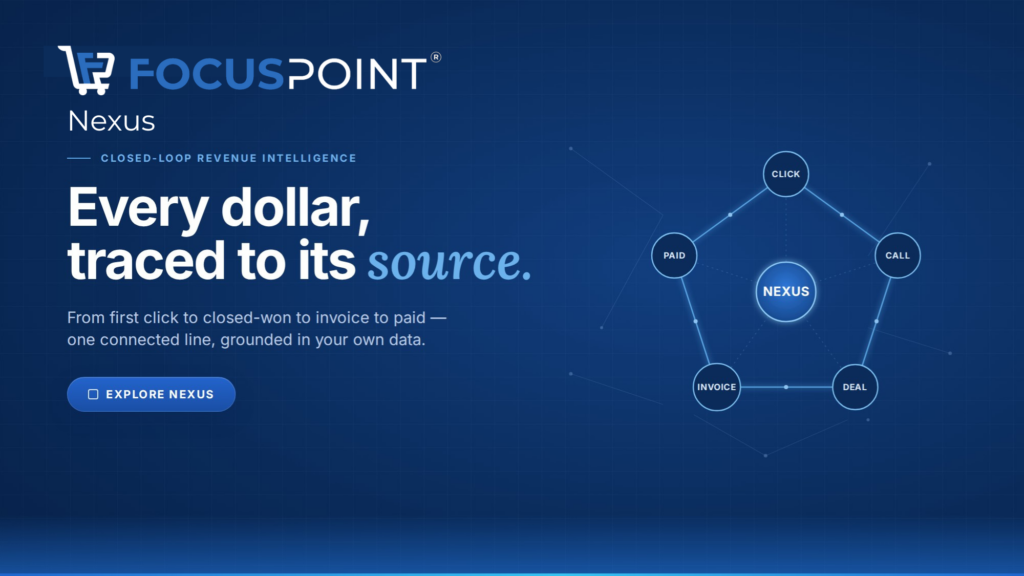
In practice, that looks like this. A deal slips past its expected close date. The AI agent flags it, drafts the follow-up for the rep, and posts the weekly digest update without anyone having to write it. A goal falls below the early-warning threshold. The agent connects that shortfall back to the specific pipeline gaps driving it and surfaces the recommended conversation for the CRO’s next review. A strategic win closes. The agent connects that outcome through the closed-loop revenue intelligence chain, from the original marketing investment to the invoiced revenue.
These agents for business strategy are not on a roadmap. They are shipped and running today. The distinction matters because the market is full of announced AI strategy features that have not been delivered. Nexus is in production.
The human always decides. The agent does the work of getting the decision to the right person at the right moment, with the right context already assembled.
The Intelligence Underneath It All
The reason Nexus can be trusted to project, cascade, and act is the foundation it sits on. This is not a dashboard connected to a data warehouse. It is a knowledge graph built on a structured taxonomy and ontology that normalizes how every system in your tech stack defines the same entities: customer, deal, revenue, close date, qualified lead.
When you ask Nexus a plain-English question, the answer is grounded in your own data through retrieval-augmented generation, not generic assumptions from a language model. When an answer comes back at Amber confidence, you know to pressure-test it. When it comes back Green, you can move on it.
Anyone in the company can correct an answer in plain English. The platform learns from the correction and applies it going forward, for everyone. This is how the intelligence compounds. The longer you run on Nexus, the more precisely it understands your business, your definitions, and your decision patterns. A year in, it is not the same platform you deployed. It understands your business more precisely, responds faster, and applies your specific definitions and decision patterns in ways the deployed version could not.
The Platform That Executes, Not Just Reports
FocusPoint Nexus works across any tech stack. It is not tied to a specific ERP or CRM. If your systems include Salesforce, HubSpot, a finance platform, paid channels, call tracking, and a web analytics stack, Nexus connects them into a single decision surface without requiring you to change any of them.
Single module access starts at approximately $30,000 per year. A three-module configuration starts at approximately $75,000. Full Nexus, covering all five C-suite roles with cross-module intelligence, starts at approximately $120,000. For select strategic accounts, an outcome-aligned option is available where a portion of the pricing is tied to revenue leakage recovered in year one. The structure is designed for reduced risk and faster ROI, not for locking in a long contract before value is proven.
Strategy does not fail because leaders set the wrong goals. It fails because the operating system underneath it is retrospective. FocusPoint Nexus changes that operating system. Live projection, weekly rhythm, full goal cascade, and AI teammates that move work forward. All of it in production. None of it on a roadmap.
FocusPoint Nexus doesn’t just report your strategy. It drives it.
Ready to see it running against your actual goals? Book a discovery call with the FocusPoint team and walk through what Nexus would look like inside your operating rhythm.
Frequently Asked Questions
What is a business strategy platform?
A business strategy platform is software that connects goal-setting, execution tracking, and decision-making into a single operating system. Unlike reporting tools that show historical data, a true business strategy platform projects outcomes forward, cascades goals to every level of the organization, runs the weekly operating cadence, and surfaces decisions while there is still time to act on them.
How is FocusPoint Nexus different from a BI or dashboard tool?
FocusPoint Nexus is not a BI tool or dashboard product. Dashboards report what already happened. Nexus projects where every goal will land before the period closes, runs a guided weekly operating rhythm with an AI teammate, cascades goals from the company level to the individual, and deploys AI agents that follow up on slipping work and connect outcomes to real revenue. It is an operating system, not a reporting layer.
Does FocusPoint Nexus require SAP Business One?
No. FocusPoint Nexus is ERP-agnostic and connects across any tech stack, including CRM platforms, financial systems, paid channels, call tracking, and web analytics. SAP Business One is not required. That requirement applies to a separate product, FocusPoint Ecommerce. Nexus works wherever your data lives, regardless of the systems running your business.
What do the AI agents actually do?
The AI agents in FocusPoint Nexus follow up on slipping deals, draft executive updates, post the weekly digest, flag anomalies before the period closes, and connect strategic wins back to closed-loop revenue intelligence. They operate within human-defined boundaries and the human always makes the final decision. These agents are in production today, not on a roadmap.
How does Nexus project where a goal will land?
Nexus pulls live data from every connected system, models the current trajectory against the defined target, and calculates a projected period-end outcome continuously throughout the period. Each projection carries a confidence signal (Green, Blue, or Amber) so leaders know how much weight to place on it. Early-warning notifications surface when a goal is tracking toward a shortfall with enough lead time to act.
Who inside a company uses Nexus?
Nexus is built for the full C-suite and the teams that report to them. The CFO uses Finance Nexus for closed-loop revenue intelligence and leakage recovery. The CMO uses Marketing Nexus for cross-source campaign ROI. The CRO uses Sales Nexus for pipeline velocity and deal health. The COO uses Ops Nexus for throughput and integration monitoring. Full Nexus gives every seat a shared decision surface with Customer-360 visibility.