Your ecommerce channel is either growing revenue or hiding why it isn’t. For SAP Business One companies running distribution, manufacturing, or complex B2B operations, that distinction matters more in 2026 than it ever has.
Most companies in this space added ecommerce because buyers started asking for it. They stood up a portal, connected some product data, and called it a digital channel. Orders trickled through. The sales team still handled the complex accounts. Nothing much changed at the revenue line.
That’s not ecommerce working. That’s ecommerce coexisting with your real business while the gap between what it could do and what it actually does grows quietly every quarter.
The companies pulling ahead right now aren’t adding more channels. They’re rebuilding the relationship between their ecommerce infrastructure and their ERP, specifically SAP Business One, so that the platform itself becomes the growth engine, not just the order-entry interface.
What It Actually Means to Use SAP for Ecommerce Revenue
The clearest way to understand this shift is to separate two very different ideas: ecommerce as a channel and ecommerce as a revenue engine.
A channel receives orders. It processes transactions. It reduces some phone volume. Metrics look fine on paper because someone is buying through it.
A revenue engine drives order volume, increases average order value, protects margins, automates the workflows that once required a rep’s attention, and generates compounding customer loyalty over time. It doesn’t just process what your buyers already decided to buy. It shapes what they decide.
For SAP Business One companies, this distinction is everything. SAP already holds the most valuable commercial data in the business: customer-specific pricing, negotiated terms, account history, credit status, product relationships, and operational context. An ecommerce engine that’s built natively on top of that data can do something a generic platform never can. It can make every buyer’s session feel like it was built specifically for them, because it was, drawn directly from the account data already living in SAP.
That’s not a feature. That’s a structural advantage.
Why Generic Ecommerce Platforms Stall in B2B Distribution
Take a mid-size industrial distributor running SAP Business One. They have 800 active accounts. Each one carries different pricing tiers, order minimums, product restrictions, and approval workflows. A few accounts order on EDI. Several go through punchout catalogs. A handful have custom delivery terms baked into their agreements.
A generic ecommerce platform cannot hold that complexity without middleware, custom development, and ongoing reconciliation work. In practice, that means the platform shows approximate pricing, the sales team spends time correcting discrepancies, and buyers who encounter friction revert to calling in. The digital channel becomes a partial solution surrounded by manual workarounds.
The result is predictable: ecommerce never becomes a true revenue driver because it can never fully represent the commercial reality inside SAP. Every gap between what SAP knows and what the platform shows is a gap in buyer trust, and buyer trust is the currency that drives self-service adoption, repeat order volume, and long-term account retention.
This is the specific problem FocusPoint Ecommerce was built to solve. Not for generic B2B. Not for companies on any ERP. For SAP Business One companies, specifically, where the commercial complexity is real and the platform has to be just as sophisticated as the business running it.
The Architecture That Makes SAP Ecommerce Different
Understanding why FocusPoint works differently starts with understanding what makes the architecture different from a bolt-on integration.
The platform is built on a semantic-web foundation: a structured taxonomy that normalizes terms across every connected system, an ontology that defines how entities like customers, orders, products, and invoices relate to each other, and a knowledge graph where all of that data converges into a single queryable surface. SAP Business One is the source of truth at the center, not one input among many.
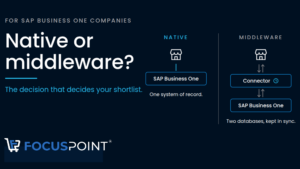
What this means operationally is that customer-specific catalogs, pricing logic, approval workflows, and account configurations aren’t synchronized from SAP; they’re derived from it in real time. There’s no middleware layer where data can drift. There’s no batch sync that creates a 24-hour window where pricing information is technically inaccurate. And because the analytics database is isolated from the operational database, heavy reporting and intelligence queries never slow the storefront down.
For a complex distribution environment, the practical difference is significant. An electrical wholesaler running 400 daily orders across 300 accounts can run AI-powered product discovery, personalized reorder suggestions, and executive attribution reporting simultaneously, without either function degrading the other.
Where Ecommerce Becomes a Direct Revenue Driver
The concrete revenue outcomes show up in three specific areas.
Average Order Value Through Intelligent Product Discovery
AI-powered search and personalization, grounded in actual SAP account history, changes how buyers move through a catalog. A buyer at a heavy equipment parts distributor who searches for a specific component sees not just that part, but the related service items, compatible accessories, and commonly repurchased items from their own order history. The recommendations aren’t generic cross-sells. They’re derived from the buyer’s real purchasing patterns inside SAP.
In practice, this lifts average order value not by pushing products at buyers, but by reducing the effort required to find what they already need.
Margin Protection Through Accurate Pricing Enforcement
Margin erosion in B2B distribution often happens quietly. A sales rep discounts to close. A pricing exception gets entered manually. A contract renewal date passes without updated terms. Over time, the gap between contracted pricing and actual order pricing costs more than most finance teams realize until they look closely.
When ecommerce is the transaction layer and SAP is the source of truth for every pricing rule, that gap closes. The platform enforces the terms that were negotiated. Exceptions require approval. Discounts route through configured workflows. Margin protection stops being a manual audit exercise and becomes a structural outcome of how orders are placed.
Revenue Growth Through Self-Service and Customer Retention
Buyers who can place orders, check account status, manage approvals, and access order history without involving your team buy more often and churn less. Not because the technology is impressive, but because the experience removes friction from a task they have to perform anyway.
For a powersports or RV parts distributor managing hundreds of dealer accounts, the compounding effect of self-service adoption across the account base is meaningful. Every account that shifts routine reorders to the digital channel reduces cost per order, frees rep capacity for higher-value conversations, and creates a more consistent buying experience that builds loyalty over time.
What Ecommerce Intelligence Looks Like in SAP
Revenue growth and margin protection are outcomes. What drives them is the intelligence layer running underneath.
FocusPoint connects ecommerce activity back to the full commercial picture inside SAP through FocusPoint Nexus, the platform’s executive intelligence layer. Where ecommerce captures the transaction, Nexus connects that transaction to every upstream and downstream data point: which marketing campaign drove the session, which sales activities preceded the account’s digital adoption, what the margin actually looked like versus what was targeted, and whether the closed-won deal ever made it to an invoice.
That last point is worth pausing on. Revenue leakage, closed-won deals that were never invoiced, or payments that were never matched to the right account, is a persistent problem in complex B2B environments. It doesn’t get caught because no one system is watching the full loop. When ecommerce, SAP operations, and executive intelligence share the same data foundation, the loop closes automatically.
Executives can ask plain-English questions about ecommerce performance and get answers grounded in the actual data: not a dashboard refresh, not a ticket to the analytics team, not a spreadsheet that may or may not reflect today’s numbers. Just a direct answer with a confidence signal and a traceable source.
Making the Shift: What This Looks Like in Practice
Moving from ecommerce as a channel to ecommerce as a revenue engine isn’t a rip-and-replace project. For most SAP Business One companies, it’s a reconfiguration of what ecommerce is expected to do.
The starting point is honest. Does your current platform fully represent your commercial reality inside SAP? Do buyers see their actual account terms, their actual pricing, their actual approval workflows? If the answer is no, you don’t have a digital channel problem. You have a foundation problem, and adding more capability on top of a broken foundation doesn’t fix it.
FocusPoint deploys in weeks, not months, because the architecture is built for SAP Business One specifically. There’s no implementation fee. No transaction fees. A monthly subscription based on the modules you actually use. That structure exists because the commercial model should match the value you get, not front-load the risk on the customer.
The trajectory from there is clear: ecommerce that drives measurable revenue growth, protects margins at the transaction level, retains customers through superior self-service, and connects every order back to the intelligence your executives need to make confident decisions.
FAQ: SAP Business One Ecommerce as a Revenue Engine
What makes SAP Business One ecommerce different from a standard B2B platform?
SAP Business One ecommerce built natively on SAP means the platform draws pricing, account terms, catalog configurations, and customer-specific logic directly from the ERP rather than synchronizing from it. This eliminates the data gaps that occur when a generic platform maintains its own copy of SAP data. For distributors and manufacturers with complex pricing and customer structures, native SAP ecommerce is the only architecture that can fully represent the commercial reality of the business without manual workarounds.
How does ecommerce increase average order value in B2B distribution?
AI-powered product discovery grounded in actual SAP purchase history surfaces relevant related items, compatible accessories, and predictive reorder suggestions at the point of purchase. Because recommendations are derived from each account’s real buying patterns rather than generic merchandising rules, they carry more relevance and reduce the friction between intent and order completion.
Can SAP Business One ecommerce protect margins automatically?
When ecommerce is the transaction layer and SAP is the authoritative source for every pricing rule, discount exception, and contract term, margin protection becomes a structural outcome rather than a manual audit process. Every order enforces the terms that were negotiated. Discount requests route through configured approval workflows. Pricing drift, the quiet margin erosion that accumulates over time in manual processes, is significantly reduced.
What is revenue leakage and how does ecommerce help prevent it?
Revenue leakage refers to closed-won deals that were never invoiced, payments that were never matched to the correct account, or contract terms that expired without enforcement. In complex B2B environments, no single system is watching the full loop from order placement through payment reconciliation. When ecommerce, ERP operations, and executive intelligence share the same data foundation, anomalies in that loop surface automatically rather than accumulating undetected.
What is the cost model for FocusPoint Ecommerce?
FocusPoint Ecommerce operates on a monthly subscription based on the modules utilized, with no implementation fee and no transaction fees. This model is designed to reduce upfront risk, accelerate time to ROI, and scale with the business. All implementation and support are provided by a dedicated team of SAP Business One professionals.
How long does deployment take?
FocusPoint Ecommerce is designed to deploy in weeks, not months. Because the platform is built exclusively for SAP Business One and doesn’t rely on middleware or custom integration development, the deployment timeline is significantly shorter than generic B2B ecommerce platforms that require extensive mapping and reconciliation work.
If your ecommerce platform isn’t actively driving revenue growth, protecting margins, and deepening customer loyalty, it’s a channel at best and a cost center at worst. FocusPoint is built to change that equation for SAP Business One companies specifically. Schedule a consultation to see exactly what that looks like for your business.