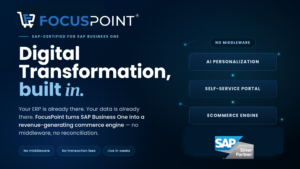
Most SAP Business One customers already have everything they need to run a serious ecommerce operation. The pricing logic, the customer hierarchies, the catalog structure, the approval workflows it’s all sitting in SAP. The problem isn’t the data. The problem is that most integration approaches force companies to build a bridge between SAP and a generic ecommerce platform. That bridge becomes expensive to build, fragile to maintain, and frustrating to operate.
This guide is for distribution and manufacturing companies that want ecommerce to actually work, not just exist. That means orders flowing without manual re-entry, customer-specific pricing showing up correctly on the first try, and the whole system scaling without adding headcount to manage it.
What SAP Business One Ecommerce Integration Actually Means
SAP Business One ecommerce integration is the process of connecting your ERP’s customer data, pricing rules, product catalog, inventory status, and order management workflows directly to a customer-facing digital commerce experience. When done correctly, a customer logs in, sees their contract pricing, browses their assigned catalog, places an order, and that transaction flows into SAP without a human touching it.
When done incorrectly (which describes most middleware-dependent setups) you get data mismatches, sync delays, pricing errors that erode margin, and a support burden that grows every time order volume increases. The integration architecture matters more than most companies realize before they’re already deep into a broken one.
Why Generic Ecommerce Platforms Fall Short for SAP B2B
Generic ecommerce platforms are built for consumer retail. They assume simple SKU lists, uniform pricing, and customers who all see the same storefront. B2B distribution doesn’t work that way.
A distributor running SAP Business One might have hundreds of customer accounts, each with unique price lists, credit terms, and approved product sets. An electrical wholesaler might have contractors who order by project with job-site delivery instructions. A heavy equipment dealer might have customers ordering parts with warranty entitlements tied to specific serial numbers.
None of that maps cleanly onto a platform designed for a consumer apparel brand. The result is always the same: extensive custom development to force the generic platform to behave like a B2B system, followed by an ongoing maintenance cost every time SAP or the ecommerce platform releases an update.
The better architecture starts from SAP and builds outward, rather than starting from a consumer platform and trying to bolt SAP onto it.
The Core Components of a Successful SAP B2B Ecommerce Integration
Customer-Specific Catalog and Pricing
In a properly integrated SAP ecommerce environment, each customer’s login surfaces their specific catalog and their specific pricing, pulled directly from SAP Business One, not from a replicated or cached table that drifts out of sync. This matters most for distributors with complex tier pricing, contract pricing, or volume-break structures. When the ecommerce engine reads from SAP as the single source of truth, pricing integrity is preserved and margin leakage from ecommerce orders is eliminated.
Order Workflow and Approval Automation
B2B orders are rarely simple transactions. Many require internal approval before fulfillment, especially for large-value orders or customers with credit holds. A well-integrated ecommerce platform extends SAP’s existing approval workflows into the digital buying experience. The customer places the order, the workflow triggers in SAP, and the right person gets notified, without anyone manually moving data between systems.
Self-Service Account Management
Customer self-service is among the highest-ROI outcomes of SAP ecommerce integration. When customers can check order status, pull invoices, review their purchase history, and reorder without calling your inside sales team, two things happen. Customer satisfaction improves because they get answers immediately. And your team’s capacity frees up for higher-value conversations instead of order status calls.
For industrial distributors and equipment dealers, this shift is significant. A customer service rep with years of product knowledge should be solving problems, not reading back order numbers.
Mobile and Multi-Channel Access
Field-based buyers (technicians ordering parts, contractors reordering supplies, rental fleet managers checking availability) increasingly place orders from mobile devices. SAP ecommerce integration that includes mobile-optimized access captures orders that would otherwise go to a competitor simply because your buying experience wasn’t available where the customer was working.
What Separates Native SAP Ecommerce from Middleware Approaches
The architectural choice that defines long-term ecommerce success for SAP Business One customers is whether the ecommerce engine is native to SAP or connected through middleware.
Middleware approaches use a third-party integration layer to sync data between SAP and the ecommerce platform. In practice, this means two systems that each maintain their own version of product, pricing, and customer data, with a sync process running between them. Sync failures create pricing errors. Data conflicts require manual resolution. Every update to SAP or the ecommerce platform risks breaking the sync.
A native approach, where the ecommerce engine reads and writes directly to SAP Business One, eliminates this entirely. There is no second copy of the data. There is no sync to manage. SAP is the system of record, and the ecommerce experience is an extension of it.
FocusPoint Ecommerce is built on this principle. No middleware, no patchwork systems, no data reconciliation overhead. The ecommerce engine runs on SAP Business One as its foundation, which means the data customers see is the same data your operations team works from.
AI-Driven Ecommerce Intelligence Within SAP
Beyond basic integration, the next layer of value in SAP ecommerce is intelligence. An AI-driven ecommerce engine doesn’t just surface products. It learns from purchasing behavior, surfaces predictive ordering suggestions, and personalizes the buying experience based on each customer’s history within SAP.
For a distributor with thousands of SKUs, AI-powered search and personalization reduces the friction of finding the right product. For a manufacturer with complex configured products, predictive ordering surfaces the items a customer is likely to need based on their cycle, their equipment, and their purchase patterns, before they think to search for them.
This is ecommerce as a growth engine, not just a self-service portal. The distinction matters because it changes the ROI conversation from cost reduction (fewer order entry staff) to revenue growth (higher average order value, increased order frequency, better customer retention).
What to Expect From Deployment
One of the most common concerns SAP Business One customers raise is deployment time. The fear is that ecommerce integration will take a year, require a large implementation team, and disrupt day-to-day operations.
With the right architecture, that’s not the experience. FocusPoint Ecommerce deploys in weeks, not months, because the integration is built for SAP Business One specifically, not adapted from a generic platform. There’s no implementation fee and no transaction fees. The subscription is based on the modules you use, which means you start with what you need and scale as the business grows.
The fastest path to go-live is a focused scope: customer login, catalog, pricing, and order submission. From there, self-service account management, advanced workflows, and AI-driven personalization layer in without disrupting what’s already working.
The Questions Worth Asking Before You Choose an Approach
Before committing to an SAP ecommerce integration approach, the questions that matter most aren’t about features. They’re about architecture and outcomes.
Does the ecommerce platform treat SAP as the system of record, or does it maintain its own copy of your data? How are pricing conflicts resolved when a sync fails? What happens to your ecommerce operation when you update SAP? Who supports the integration: the ecommerce vendor, the SAP partner, or a third-party integration firm? And what does the total cost of ownership look like at year three, not just at launch?
These questions separate platforms built for B2B SAP environments from platforms adapted for them. The answers define whether ecommerce becomes a scalable revenue channel or an ongoing operational liability.
Making Ecommerce a Revenue Driver, Not Just a Channel
The companies that get the most from SAP Business One ecommerce integration are the ones that treat ecommerce as a strategic growth driver from the start. This is not a convenience layer or a cost reduction project. It is a revenue surface that compounds over time as more customers adopt self-service, as AI personalization improves, and as the ecommerce data feeds better decisions across sales, operations, and finance.
For distributors and manufacturers running SAP Business One, the infrastructure for that outcome already exists. The question is whether your ecommerce integration is built to use it, or built around it.
If you’re evaluating SAP Business One ecommerce integration and want to understand what native, AI-driven ecommerce looks like in practice for your industry, book a discovery call with the FocusPoint team. We’ll walk through your specific environment, your customer base, and what a deployment timeline realistically looks like for your business.
FAQ
What is SAP Business One ecommerce integration? SAP Business One ecommerce integration connects your ERP’s customer data, pricing, product catalog, and order workflows to a digital commerce experience. When properly integrated, customers see their contract pricing, browse their assigned catalog, and place orders that flow into SAP automatically, without manual re-entry or data reconciliation.
Why don’t generic ecommerce platforms work well for SAP B2B? Generic ecommerce platforms are designed for consumer retail with uniform pricing and simple catalogs. SAP Business One B2B environments involve customer-specific pricing, complex approval workflows, and account hierarchies that generic platforms can’t support natively. Forcing a fit requires extensive custom development and ongoing maintenance that grows more costly over time.
What is the difference between native SAP ecommerce and middleware integration? Native SAP ecommerce reads and writes directly to SAP Business One as the system of record, with no sync layer between systems. Middleware integration maintains a separate copy of product, pricing, and customer data and syncs it between SAP and the ecommerce platform. Middleware approaches introduce sync failures, data conflicts, and ongoing reconciliation overhead that native approaches eliminate entirely.
How long does SAP Business One ecommerce integration take to deploy? With a platform built specifically for SAP Business One, deployment typically takes weeks rather than months. The key variable is scope. A focused initial deployment covering customer login, catalog, pricing, and order submission goes live fastest. Advanced workflows, AI personalization, and self-service account management layer in afterward without disrupting the live environment.
What industries benefit most from SAP B2B ecommerce integration? Industrial distributors, electronics and electrical wholesalers, heavy equipment dealers, equipment rental operations, and manufacturers with complex B2B customer relationships see the strongest results. These are environments where customer-specific pricing, catalog control, and workflow automation provide the most operational leverage.
What should I look for in an SAP ecommerce vendor? Prioritize vendors who treat SAP as the system of record rather than connecting to it through middleware. Ask how pricing conflicts are resolved, who owns the integration support relationship, what the total cost of ownership looks like at year three, and whether the platform supports AI-driven personalization and self-service account management natively.